
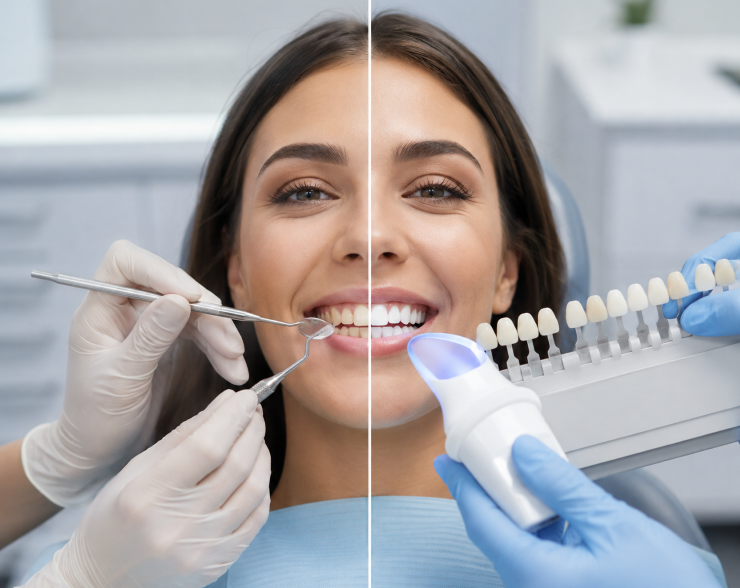
You brush regularly, yet your teeth still look yellow or stained. Should you book a cleaning, or do you need whitening? Choosing the wrong one can be disappointing — a cleaning cannot always change naturally yellow or internally discoloured teeth, and whitening cannot remove hardened tartar or replace routine oral care. The comparison between teeth cleaning vs teeth whitening comes down to one simple fact: both can improve how stained teeth look, but they work on completely different problems.
Why teeth become stained
Not every stain has the same cause, and that’s exactly why cleaning and whitening don’t produce the same results. Broadly, staining falls into two categories — one that sits on the tooth surface, and one that develops inside the tooth itself.
Surface (extrinsic) stains
These sit on the outer tooth, most often caused by:
- Coffee, tea, and red wine
- Tobacco
- Dark-coloured foods
- Plaque and tartar buildup
- Inconsistent brushing and flossing
They usually respond well to professional cleaning and polishing. Whitening toothpaste can help too, but it never changes the colour inside the tooth.
Internal (intrinsic) discolouration
This develops within the tooth itself, commonly from:
- Natural tooth colour and ageing
- Certain childhood medicines
- Injury to a tooth
- Changes after infection or root canal treatment
- Excess fluoride during tooth development
Whitening may improve some of this, but results depend entirely on the cause. Some teeth need a different cosmetic or restorative approach altogether.
What a professional cleaning removes
A cleaning is primarily an oral-health treatment, not a cosmetic one. It removes:
- Soft plaque
- Hardened tartar
- Deposits around the gumline
- Some surface stains
- Buildup between teeth that brushing misses
Tartar cannot be removed safely at home — it needs hand instruments or ultrasonic equipment.
Will cleaning make teeth look whiter?
Often, yes — once deposits are gone, teeth look cleaner and brighter. But cleaning does not bleach teeth or change their natural underlying shade. Someone whose teeth are yellow mainly from tartar and coffee stains may see a clear improvement; someone whose teeth are naturally yellow may notice little colour change at all.
How teeth whitening works
Whitening uses agents such as hydrogen peroxide or carbamide peroxide to break down coloured compounds inside the tooth, which is why it can change the visible shade of natural teeth in a way cleaning cannot. Common options include:
- Dentist-supervised take-home whitening
- In-office professional whitening
- Approved over-the-counter whitening products
- Whitening toothpaste, for surface stains only
Results are not the same across all of these.
Which stains respond best?
Whitening tends to work better on general yellowing and food, drink, or age-related staining. Grey, deeply discoloured, injured, or medication-stained teeth often respond differently and need assessment first.
Cleaning vs whitening at a glance
| Point | Cleaning | Whitening |
| Main purpose | Oral health | Cosmetic colour |
| Removes plaque/tartar | Yes | No |
| Removes surface stains | Often | Yes |
| Changes natural shade | No | Yes |
| Treats gum buildup | Yes | No |
| Works on crowns/fillings | Not applicable | No |
Only natural teeth respond to whitening — crowns, veneers, bridges, bonding, and tooth-coloured fillings will not lighten, which can create an uneven look if this isn’t planned for.
Should cleaning come before whitening?
Usually, yes. A few reasons why:
- Plaque and tartar can interfere with an even whitening result
- An examination can catch cavities, gum inflammation, cracks, or exposed roots that need attention first
- Removing surface stains often reveals the tooth’s actual colour underneath — sometimes that alone is enough of an improvement
Whitening should never be used to mask untreated dental problems.
Is whitening safe?
Dentist-supervised whitening is generally considered safe for suitable candidates, with temporary sensitivity or gum irritation being the most common effects. An assessment matters especially for anyone with:
- Tooth sensitivity or cavities
- Gum disease
- Cracked or worn teeth
- Exposed roots
- Multiple crowns or veneers
- A single tooth that has suddenly darkened
Uncontrolled online products and home remedies used without guidance can damage enamel or irritate gums.
A simple way to decide
Not sure which situation applies to you? Here’s a quick way to tell.
Choose cleaning first if
- Tartar is visible near the gums
- Gums bleed while brushing
- It’s been a while since a professional cleaning
- Stains are mainly from coffee, tea, or tobacco
- Teeth feel rough or coated
Consider whitening if
- Teeth are healthy but still look yellow
- Cleaning didn’t give the colour change wanted
- Discolouration affects several teeth
- A dentist has confirmed whitening is suitable
Consider both if
There’s surface buildup as well as deeper discolouration. In that case, cleaning comes first, and whitening follows once the mouth is healthy.
Keeping results in place
Neither treatment prevents staining forever, but the right habits stretch the results much further.
After cleaning
- Brush twice daily with fluoride toothpaste
- Clean between teeth daily
- Limit tobacco
- Rinse with water after staining drinks
- Keep up regular checkups
After whitening
- Limit frequent coffee, tea, red wine, and tobacco
- Follow the dentist’s instructions
- Avoid excessive touch-ups
- Remember results fade gradually over time
In summary
Teeth cleaning and teeth whitening solve different problems — cleaning removes harmful deposits and many surface stains, while whitening changes the colour of healthy natural teeth. For anyone specifically exploring teeth whitening in Kolkata, a dental examination can help determine whether cleaning, whitening, both, or another option is appropriate. Such concerns are best addressed through a professional evaluation, and one may consider getting a consultation with a dentist to plan the right approach.
Author:
Dr. Sayak Gupta
BDS, MDS (Conservative Dentistry & Endodontics)
FICOI (USA), Assoc. Fellowship – Laser Dentistry (WCLI, USA)
Frequently asked questions
1. Can teeth cleaning remove yellow stains?
Cleaning may remove yellow deposits and external stains caused by plaque, tartar, food, drinks, or tobacco. It will not significantly change teeth that are naturally yellow or discoloured from within.
2. Should I get cleaning or whitening first?
Cleaning usually comes first when plaque, tartar, or gum inflammation is present. Once teeth and gums are clean and healthy, it can be assessed whether whitening is still needed.
3. Can whitening remove tartar?
No. Whitening gel changes tooth colour but does not remove hardened tartar. Tartar has to be removed professionally with the right dental instruments.
4. Will crowns and fillings become whiter?
No. Whitening products work on natural teeth only, not crowns, veneers, bridges, or tooth-coloured fillings. This needs to be planned carefully when visible restorations are present.
5. Why is one tooth darker than the others?
A single dark tooth may be linked to an old injury, infection, or internal changes within the tooth. It should be examined before whitening, since it may need a different treatment altogether.
This content is for general educational purposes only and does not constitute medical advice, diagnosis, or treatment. Dental conditions vary by individual; please consult a qualified dental practitioner for personal evaluation and treatment planning.