

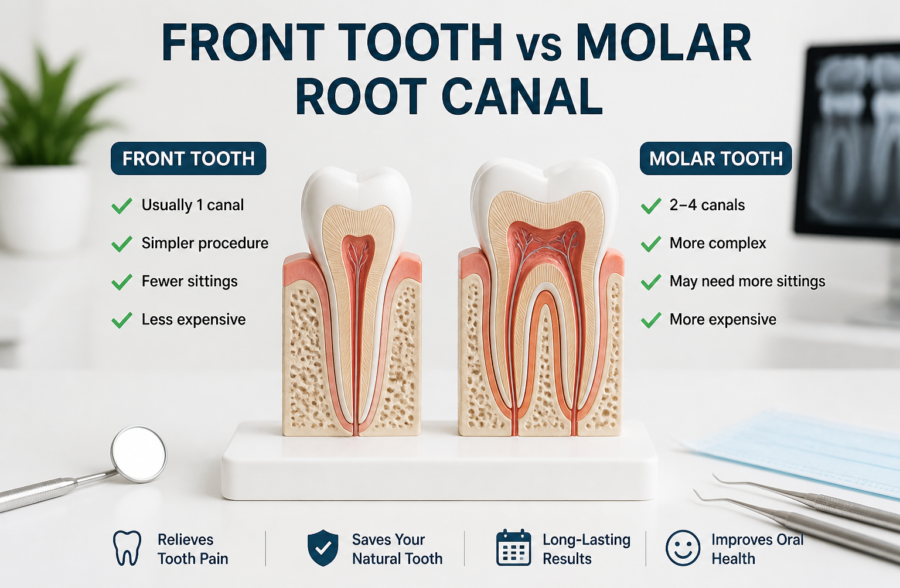
If your dentist has recommended a root canal, one of the first questions that might cross your mind is — does it matter which tooth needs the treatment? The short answer is yes, it does. While the core purpose of a root canal remains the same regardless of which tooth is involved, the procedure, complexity, recovery, and even the cost can vary quite a bit depending on whether it’s a molar at the back or a front tooth.
Understanding these differences can help you walk into your appointment feeling informed rather than anxious.
Why the Location of the Tooth Matters
Every tooth in your mouth plays a different role. Front teeth — called incisors and canines — are mainly used for biting and tearing food. Molars, on the other hand, handle the heavy work of grinding and chewing. This difference in function directly affects how each tooth is built, and therefore, how a root canal on each one unfolds.
It is not just about location. It is about anatomy.
Front Tooth Root Canals: Simpler, But Not Always Easy
Front teeth generally have a single, straight root canal. This makes the procedure relatively more straightforward for a root canal specialist to navigate. The canal is easier to access, easier to clean, and easier to seal — which typically means fewer sittings and a faster procedure overall.
That said, “simpler” does not mean without nuance. Front teeth are highly visible, so aesthetics matter a great deal here. After the root canal, the tooth can sometimes darken over time due to internal changes. A good specialist accounts for this and plans the restoration accordingly — usually with a tooth-coloured crown or an internal bleaching procedure if needed.
Front tooth root canals are also slightly less painful post-procedure compared to molars, simply because there is less surrounding tissue involvement.
Molar Root Canals: More Complex, More Precision Required
Molars are a different story altogether.
A molar typically has two to four root canals — sometimes even more. Each canal needs to be individually located, cleaned, shaped, and sealed. This level of detail requires advanced equipment, significant expertise, and more time in the chair.
The canals in molars are also narrower, more curved, and harder to reach. This is where the skill of a root canal specialist genuinely makes a difference. An experienced endodontist using rotary instruments and digital imaging can navigate these complexities with a level of precision that general dentists often cannot match.
Molars also bear the most chewing pressure in your mouth, which means the restoration after treatment — almost always a dental crown — is non-negotiable. Without a crown, a root canal-treated molar is vulnerable to fracture.
The Difference in Number of Sittings
For front teeth, a root canal can often be completed in a single sitting at a well-equipped clinic.
Molar root canals, because of their complexity, may require two sittings — sometimes more — depending on the degree of infection, the number of canals, and how well the tooth responds to treatment between sessions. This is completely normal and should not be a cause for concern.
Does Root Canal Treatment Cost Differ Between the Two?
Yes, and this is one of the most common questions patients ask.
Root canal treatment cost in Kolkata varies depending on the tooth involved. Front teeth, being simpler to treat, are generally less expensive. Molars, due to the added complexity, time, and materials involved, cost more. The type of restoration placed afterward — a simple filling vs. a full crown — also adds to the total.
Always ask for a complete cost breakdown before beginning treatment, including the crown cost if applicable. Transparency in pricing is a hallmark of any best dental clinic in Kolkata worth trusting.
Does One Hurt More Than the Other?
Both procedures are performed under local anaesthesia, so you should not feel pain during the treatment itself. Post-procedure soreness is more common after molar root canals simply because the area is larger and more tissue is involved. This usually settles within two to three days with basic pain management.
Which One Is More Likely to Need Retreatment?
Molars have a higher chance of requiring retreatment down the line, primarily because of their complex canal anatomy. A canal that was missed during the first treatment, or one that was not fully sealed, can harbour bacteria and cause reinfection. This is precisely why choosing a specialist with advanced diagnostic tools matters so much.
Front teeth, being anatomically simpler, tend to have more predictable long-term outcomes — provided the restoration is done correctly.
The Right Hands Make All the Difference
Whether it’s a front tooth or a deeply rooted molar, the outcome depends heavily on who is treating you. At Precision Dental & Implant Centre, root canal treatments are performed by Dr. Sayak Gupta — a specialist in Conservative Dentistry and Endodontics with over 10 years of experience handling everything from straightforward single-canal cases to the most complex molar treatments.
Experiencing tooth pain or being advised a root canal? Book a consultation with Dr. Sayak Gupta today and get a clear, honest treatment plan from one of the most trusted root canal specialists in Kolkata.
FAQs: What People Also Ask
Is a root canal on a molar more painful than on a front tooth?
Not during the procedure, since both are performed under local anaesthesia. However, post-procedure discomfort tends to be slightly higher with molars due to the greater extent of treatment involved. It typically resolves within a few days.
How many sittings does a molar root canal take?
A molar root canal usually takes two sittings, though this can vary based on the severity of infection and the number of canals. A front tooth root canal can often be completed in a single sitting.
Is a crown always necessary after a root canal?
For molars, yes — a crown is almost always recommended because molars bear heavy chewing forces and a treated tooth becomes brittle over time. For front teeth, a crown may or may not be required depending on the amount of tooth structure remaining.
What is the cost of root canal treatment in Kolkata?
Root canal treatment cost in Kolkata varies by tooth type and clinic. Front tooth RCTs are generally more affordable, while molar RCTs cost more due to added complexity. The cost of a crown placed afterward is separate and should be factored into your total budget.
Can a general dentist perform a molar root canal, or do I need a specialist?
While general dentists can perform root canals, molar root canals with multiple curved canals are best handled by a root canal specialist — also called an endodontist — who has advanced training and specialised equipment for complex cases.