
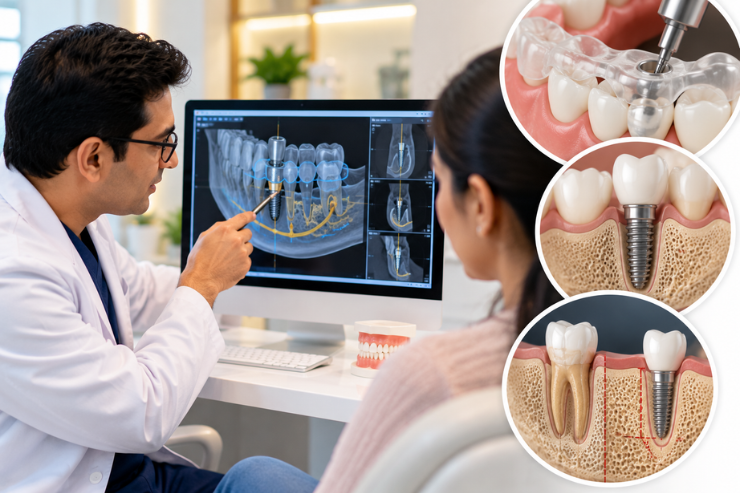
“You don’t have enough jawbone.” Hearing this can feel like a door closing. But a thin jawbone does not always rule out implants. In short: a 3D scan measures your bone, a surgical guide can help place an implant along a screen-based plan, and other options exist if the bone is very thin. Here is how guided dental implant placement works, its limits, and what to ask. However, remember, results vary from person to person.
What Is Guided Dental Implant Placement?
In guided placement, the surgery is planned on a computer first. A custom template then helps the dentist follow that plan in your mouth.
It has three parts:
- A 3D scan (CBCT): shows your bone, nerve, and sinus.
- Planning software: the dentist chooses the implant’s size, angle, and depth on screen.
- A surgical guide: a template that directs the drill to the planned spot.
In conventional (freehand) placement, the dentist also uses scans, but guides the drill by sight and feel.
How Is Guided Implant Placement Done?
Your dentist may adjust the steps to suit your case.
| Step | What happens |
| 1. 3D scan | A CBCT shows bone width, height, nerves, and sinuses |
| 2. Digital impression | A handheld scanner records your teeth and gums |
| 3. Planning | Size, angle, and depth are set on screen |
| 4. Guide | A custom guide is made from the plan, often 3D printed |
| 5. Surgery | The guide is fitted, and the drill follows its tubes |
| 6. Healing and crown | The bone fuses with the implant, then the crown is made |
How Digital Impressions Support Guided Placement
A digital impression is a scan of your teeth and gums with a handheld scanner, with no tray or putty. It supports guided placement in two ways:
- Before surgery, the scan is merged with your 3D scan in planning software, so the plan shows bone, teeth, and gums together. The guide can then be made to sit on your teeth.
- After healing, it records where the implant sits, so the crown can be made.
Scanners have also improved. According to research, recent ones scan faster and continuously, need no scanning powder, and capture colour images.
Studies report good accuracy for single implants and short bridges, while full-arch evidence is still limited. Results still depend on the scanner, the scanning method, and the dentist’s experience, and a conventional impression may be preferred in some cases.
Guided vs Conventional Implant Placement
| Aspects | Conventional | Guided |
| Drill path | Set by the dentist during surgery | Directed by the guide |
| Before surgery | Fewer steps | Extra scans, planning, and guide-making |
| During surgery | Dentist adjusts freely | Changes are limited by the guide |
| Often used for | Many cases, including simple ones | Complex cases, several implants, limited bone |
Both are accepted methods. Individual results may vary.
Types of Surgical Implant Guides: Static and Dynamic
| Type | How it works | Good to know |
| Static guide | A printed template with drill tubes, fitted before surgery | The path is fixed before surgery |
| Dynamic navigation | A screen and tracking tool show the drill’s position live | The dentist still moves the drill by hand |
Research found that dynamic navigation reached accuracy similar to static guides.
Guided Dental Implants in Kolkata: Who Is It For?
A dentist may consider guided placement when:
- Several implants are planned
- Bone is limited, or the nerve or sinus is close
- The final teeth need to be planned before surgery
Conventional placement may suit:
- Simple cases with good bone
- Mouths that cannot open wide enough for guided tools
The decision is made together with your dentist, so it helps to ask any dental clinic in Kolkata how your case would be planned.
Does a Thin Jawbone Rule Out Dental Implants?
Not automatically. It depends on how wide, tall, and dense your bone is, and which part of the jaw is involved. Only a scan can show this.
Bone shrinks after a tooth is lost because it no longer gets chewing pressure, and often more after years of removable dentures in Kolkata or elsewhere.
If you are exploring dental implants in Kolkata with thin bone, a guided plan may help the dentist:
- Pick an implant size that fits the bone
- Choose an angle that uses the bone available
- Stay clear of the nerve and sinus
A guide does not create bone. Very thin bone may need extra steps:
| Option | What it is |
| Angled placement | The implant is tilted slightly to use the bone that is there |
| Narrow implants | Thinner implants made for thin ridges |
| Ridge expansion | The ridge is gently widened during surgery |
| Bone grafting | Bone material is added, with extra healing time |
The evidence for these options varies in quality, and research reports complications with some, such as infection or tingling. Individual results may vary. If a case needs steps beyond what your dentist offers, referral to a surgeon is part of careful care.
What Does Recovery Look Like After Guided Placement?
Recovery differs for each person. Some people notice mild swelling or soreness for a few days. Your dentist will explain what to expect for your case.
- In some cases, the gum does not need to be lifted. In thin bone, a small flap is often needed so the dentist can see the bone.
- The bone needs time to fuse with the implant. According to medical references, this may take about three to nine months.
- Report pain or swelling that keeps increasing, a loose implant, or numbness and tingling in the lip or chin.
You Can’t Judge Bone Thickness From the Mirror
A thin jawbone is a reason to plan carefully, not always a reason to give up on implants. Guided placement is one tool. Narrow implants, ridge expansion, and grafting are others. Each has advantages and limits, and the right mix differs for every mouth.
You cannot judge your bone thickness by looking in the mirror or touching your gums. A 3D scan is how dentists measure it. If you are considering dental implants in Kolkata, ask your treating doctor what your scan shows and which options apply to you.
Author:
Dr. Sayak Gupta
BDS, MDS (Conservative Dentistry & Endodontics)
FICOI (USA), Assoc. Fellowship – Laser Dentistry (WCLI, USA)
Frequently Asked Questions
1. What is the difference between guided and regular implant placement?
In regular (freehand) placement, the dentist guides the drill by sight and feel. In guided placement, a plan made on screen and a custom template direct the drill. Both are accepted methods, chosen case by case.
2. Is guided implant surgery painful?
Local anaesthesia numbs the area, so many people feel pressure rather than sharp pain. Soreness afterwards varies from person to person. Your dentist will explain pain control for your case.
3. Is guided implant surgery safer than regular implant surgery?
Not clearly. Guided placement may lower anatomical risk in complex cases, and long-term results are similar. Safety depends more on planning, the dentist’s skill, and your health. Individual results may vary.
4. Can guided placement be done with a thin jawbone?
Sometimes. A 3D scan shows how much bone you have. A guide helps follow the plan, but it cannot add bone. Narrow implants, ridge expansion, or grafting may be discussed.
5. How long does guided implant treatment take?
It varies. Scans and planning come first, then surgery, then months of healing before the crown. A graft adds time. Your dentist will give a timeline based on your scan and healing.
Disclaimer: This content is for general educational purposes only and does not constitute medical advice. Individual results may vary. Please consult your treating doctor for a personalised assessment before starting any treatment.