By the time most people consider full-mouth rehabilitation, they have been compensating for years. They favour one side while chewing, avoid certain foods and smile with a little hesitation. The question that follows is almost always about cost.
From a clinical standpoint, the full-mouth rehabilitation cost in Kolkata cannot be expressed as a single figure. It depends on the condition of your teeth, the treatment each one needs, and the materials and laboratory work involved. This guide explains each factor clearly, so that any estimate you receive can be understood and compared with confidence.
As a general reference, full-mouth rehabilitation in India commonly ranges from ₹1.5 lakh to over ₹10 lakh. These figures are indicative only. An accurate estimate is possible only after a thorough examination.
Why there is no single standard full-mouth rehabilitation price
Full-mouth rehabilitation is not one procedure. It is a carefully sequenced plan that restores the health, function and appearance of your teeth, gums and bite together.
For one patient, this may mean crowns on worn teeth. For another, it may involve gum treatment, root canals and several implants. The total reflects that difference. Five factors account for most of the variation:
- Number of teeth involved
- Treatment required for each tooth
- Materials selected
- Number of stages and visits
- Laboratory quality and clinical planning
The examinations and records needed before an estimate
A dependable estimate begins with a thorough diagnosis. Without one, any figure is an approximation at best.
Clinical assessment, imaging, photographs and bite analysis
A complete assessment usually includes:
- Clinical examination of the teeth, gums and jaw joints
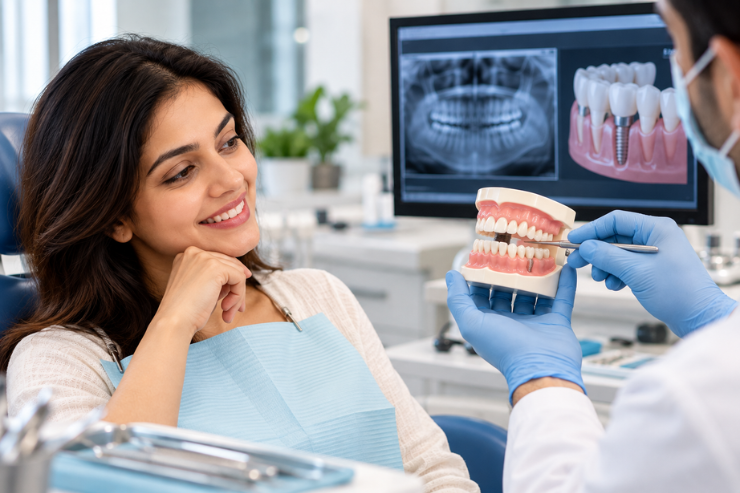
- X-rays or 3D scans to assess roots, bone and hidden decay
- Photographs to record tooth shade, shape and smile line
- Bite analysis to understand how the upper and lower teeth meet
- Impressions or digital scans to design the new teeth
Some clinics charge separately for these records. They form the foundation of the plan and help avoid unexpected changes later.
How the number and condition of teeth affect cost
The more teeth that need treatment, the higher the overall cost. Their condition influences the price just as much.
Healthy teeth that need only protective crowns are the most economical to treat. Heavily worn or fractured teeth often need rebuilding before a crown can be placed. Missing teeth call for bridges or implants, which cost more than crowns. If the jawbone has weakened, a bone-strengthening procedure may be advised before an implant.
General health matters as well. Smoking and poorly controlled blood sugar can slow healing and may extend the treatment plan.
Treatment components that may be included
Most plans combine several treatments, although few patients need all of them. The ranges below are approximate and vary between clinics and cases.
Gum treatment, root canals, crowns, bridges and implants
- Gum treatment (₹3,000–₹15,000): clears infection so that the new work remains stable.
- Root canal treatment (₹3,000–₹8,000 per tooth): saves a tooth whose inner nerve is damaged.
- Crowns (₹5,000–₹30,000 per tooth): protect and reshape weakened teeth.
- Bridges (priced per tooth unit): replace a missing tooth by anchoring to the teeth beside it.
- Implants (₹25,000–₹75,000 each): replace both the missing tooth and its root.
- Dentures: removable teeth, generally the most affordable option, though they feel different from natural teeth.
How crown material and laboratory work influence the estimate
Material choice is one of the clearest reasons why two estimates differ.
| Material | Appearance | Strength | Cost level |
| Metal-based porcelain | Good | Strong | Lower |
| Zirconia | Very natural | Very strong | Medium to high |
| All-ceramic | Most natural, ideal for front teeth | Moderate to strong | High |
Laboratory work matters just as much. A skilled technician shapes each tooth to suit your bite and smile, and digital design improves accuracy. Higher-quality lab work costs more, but it usually means a better fit, fewer adjustments and longer-lasting results.
How treatment stages and temporary teeth affect the quote
Most full-mouth cases are completed in phases over several weeks to a few months. A typical sequence looks like this:
- Planning: records are reviewed and the plan is explained.
- Preparation: gum infection and decay are treated.
- Surgical phase: extractions or implants are done, followed by healing. Implants generally need three to six months.
- Temporary teeth: worn while the final set is being made.
- Final teeth: placed and fine-tuned for comfort and bite.
- Review: follow-up visits to confirm everything is working well.
Temporary teeth allow you to eat, speak and smile normally during treatment. It is worth asking whether they are included in the quote or billed separately.
What to check in a written treatment estimate
A written estimate protects both you and your dentist. Read it carefully before agreeing to proceed.
Inclusions, exclusions, alternatives, maintenance and warranty terms
- Inclusions: which treatments, materials and visits are covered.
- Exclusions: what may cost extra, such as scans, temporary teeth or repairs.
- Alternatives: a more economical option, and what it changes in terms of look or durability.
- Maintenance: regular cleanings, a night guard if you grind your teeth, and daily care.
- Warranty: what is covered, for how long, and what could void it.
- Payment structure: whether payment is stage by stage or in one sum.
A second opinion is a reasonable step for a treatment of this size, and a good clinician will welcome it.
Planning Your Treatment with Confidence
Understanding what shapes the full mouth rehabilitation cost in Kolkata allows you to evaluate a treatment plan calmly and decide with clarity. Every mouth is different, and the right plan is one that is based on a proper examination and explained in full. Those who wish to understand their individual options may consult a qualified dentist at a time that suits them.
Author:
Dr. Sayak Gupta
BDS, MDS (Conservative Dentistry & Endodontics)
FICOI (USA), Assoc. Fellowship – Laser Dentistry (WCLI, USA)
Frequently Asked Questions
1. What is the average cost of full mouth rehabilitation?
Most people spend between ₹1.5 lakh and ₹10 lakh or more. A smaller case with a few crowns falls at the lower end, while a case involving several implants costs more.
2. Why do different dentists give such different quotes?
Quotes differ because of the materials used, the quality of lab work, the number of teeth included and the tests done beforehand. When comparing, look at what each quote includes rather than only the final number.
3. How long does the treatment take?
Simple cases may be completed in a few weeks. Cases involving implants or bone-strengthening can take four to eight months, because the jaw needs time to heal.
4. Is full mouth rehabilitation painful?
The treatment is done under numbing medicine, so you should not feel pain during the procedure. Mild soreness for a few days afterwards is common and usually settles with simple medicines.
5. Can I pay in parts, or will insurance help?
Many clinics allow payment stage by stage, and some offer EMI options. Insurance usually covers only treatment needed for health reasons, so check your policy before beginning.
This blog is for general educational purposes only and is not a substitute for professional medical or dental advice, diagnosis or treatment. The costs and treatment options mentioned are indicative and vary from person to person. Please consult a qualified dental professional for guidance specific to your condition.