
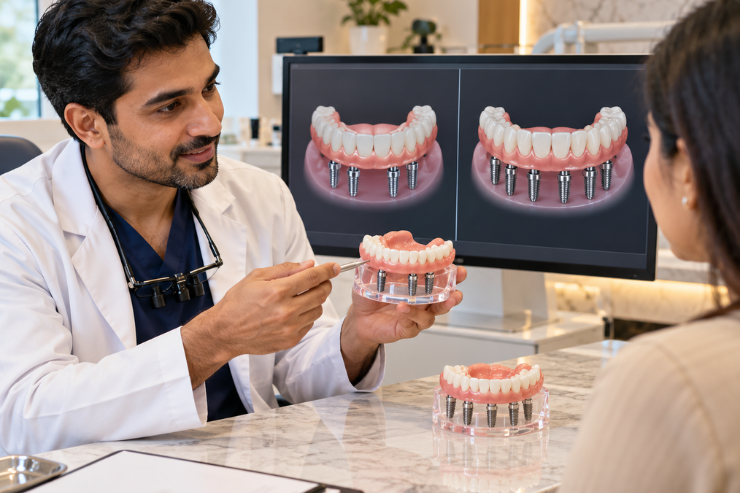
- All-on-4 and All-on-6 are two ways of supporting a full arch of fixed teeth on dental implants, using four or six implants.
- The number is an outcome of planning, not a rule. It follows your bone volume, jaw anatomy, bite forces, and the design of the bridge.
- The real difference is how load is shared and how the bridge is planned. A 3D scan and a bite assessment make this visible.
Patients often arrive asking, “Which is better, four or six?” It is a fair question, but it starts from the wrong end. During dental implant treatment, the count usually comes out of proper planning, as the upper and lower arches of the same patient can call for different designs.
If you are comparing all-on-4 vs all-on-6 dental implants in Kolkata, this blog covers what the terms mean and the clinical reasoning behind the choice.
What All-on-4 and All-on-6 describe
As mentioned earlier, both terms describe a way of supporting a full arch of fixed teeth on dental implants.
- All-on-4: a full-arch bridge supported by four implants, often with the back two placed at an angle.
- All-on-6: the same idea, supported by six implants.
They are treatment concepts, not fixed packages. The final design is worked out for each jaw.
Bone Volume, Jaw Anatomy, Bite Forces, And Prosthesis Design
As a dentist, we had to consider several things together:
- Bone volume: height, width, and density, checked on a 3D CBCT scan.
- Jaw anatomy: the position of nerves and sinuses, and the shape of the arch.
- Bite forces: strong biters and people who grind their teeth place more load on a bridge.
- Prosthesis design: the material, the length, and how far the bridge extends beyond the last implant.
- General health: gum health, healing capacity, smoking, and conditions such as diabetes.
Together, these assist in determining how many implants are required, position to be placed, and at what angle.
How Support And Load Distribution May Differ
Chewing force passes through the bridge into the implants, and then into the bone. More implants can share that force across more points. Fewer implants can also support a bridge well when they are positioned thoughtfully for the jaw.
Placement and spacing often matter equally to implant count. Implants set well apart, with a bridge designed to keep its extensions short, spread the load more evenly.
Do Both Options Provide Fixed Teeth?
Usually, yes. Both are commonly designed as fixed bridges screwed onto the implants. You do not take them out at home, but your dentist can remove the bridge during check-ups for deep cleaning or repair.
Some people are offered an implant-supported removable denture instead. That is a different design with its own planning.
Can Temporary Teeth Be Fitted During Treatment?
Sometimes. If the implants are stable enough at placement, a temporary bridge may be fitted within days. It is meant for light function and appearance while the bone heals.
If stability is lower, or grafting is involved, your dentist may advise a longer healing period first, often with a temporary denture. This is decided at surgery, based on how the implants sit in the bone. Soft foods and gentle care are advised in either case.
Dental Implants: How Cleaning And Maintenance Compare
Daily care is similar for both all-on-4 and all-on-6 dental implants in Kolkata. Both need thorough cleaning around and under the bridge.
- A soft brush, used twice a day
- Interdental brushes or floss threaders for the spaces under the bridge
- A water flosser, if your dentist recommends one
- Regular professional cleaning and review, at intervals your dentist sets
- A night guard if you grind your teeth
Implant positions and bridge shape change which areas are easier to reach, so your dentist will show you a routine matched to your design.
What Happens if an Implant Develops a Problem Later?
Problems can happen with any implant. Examples include gum inflammation around it (peri-implantitis), a loose screw, or a chipped bridge. Early signs are bleeding gums, tenderness, swelling, a bad taste, or a bridge that feels different. Please report these early.
How a problem is managed depends on the design and the cause. Options may include deep cleaning, medication, adjusting the bridge, or replacing a component. With more implants, your dentist may have more flexibility in adjusting the plan, but this depends on the case.
How Cost Drivers Differ Between All-On-4 And All-On-6
- Number of implants and the components for each
- Implant brand and system
- Bridge material, such as zirconia or acrylic-based, and its design
- Bone grafting or a sinus lift, if needed
- Scans, extractions, and gum or tooth treatment beforehand
- Temporary teeth and follow-up visits
More implants add components and surgical time, while bridge material and grafting can change the total as much as the implant count. When you compare written plans, compare what each includes. For additional overview, see our Full Mouth Dental Implants in Kolkata page.
Questions To Ask During Implant Planning
- Why do you recommend this number of implants for my jaw?
- Will a 3D scan be used, and can I see my bone measurements?
- Do I need grafting or a sinus lift, and why?
- Which bridge material do you suggest, and why?
- Could temporary teeth be fitted, and when?
- How do I clean the bridge, and how often are reviews?
- What happens if an implant needs attention later?
Choosing between All-on-4 and All-on-6 is a clinical decision, and it is best made after a full dental examination. If you would like to understand how these apply to your own jaw, you can contact Precision Dental and Implant Centre, a dental implant clinic in Kolkata, for more information.
Author:
Dr. Sayak Gupta
BDS, MDS (Conservative Dentistry & Endodontics)
FICOI (USA), Assoc. Fellowship – Laser Dentistry (WCLI, USA)
Frequently Asked Questions
Is All-on-6 always stronger than All-on-4?
No. More implants can share load across more points, but strength depends on bone, implant position, bridge design, and bite. Planning matters more than the number alone.
Will bone grafting always be necessary for dental implant?
No. Some plans use angled implants or available bone to avoid grafting. Others need grafting or a sinus lift. Your scan and examination decide this.
Can smokers receive full-arch implants?
Possibly, but smoking is linked to slower healing and a higher risk of gum problems around implants. Dentists often advise stopping before and after surgery. Please share your habits openly so the plan can account for them.
This content is for general educational purposes and does not constitute medical advice. Individual results vary. Please consult a qualified medical practitioner for a personalised assessment.