

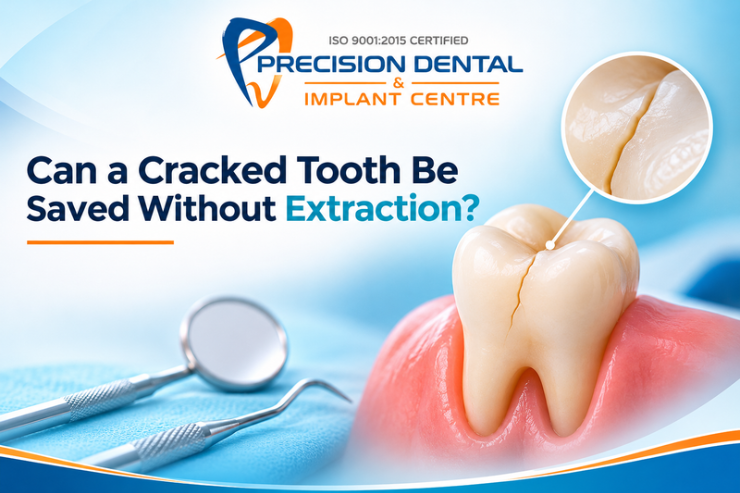
It usually starts small. You bite into something hard, feel a quick sting, and then it passes. A few days later, the same tooth reacts to cold water, or hurts only at the moment you let go of a bite. That strange, on-and-off pain is often a cracked tooth, and it is far more common than most people realise. Many patients walk into a dental clinic in Kolkata with exactly this complaint, unable to point out which tooth is the troublemaker.
The worry that follows is almost always the same: will I lose this tooth? Not necessarily. Many cracked teeth can be saved, and the outcome depends on how deep the crack goes, where it sits, and how soon it is looked at.
Types of Cracked Teeth and Their Outcomes
Not every crack is the same. The type of crack largely decides whether the tooth can be saved.
Craze Lines
These are very fine lines on the outer enamel. They are common in adults, usually painless, and rarely need treatment. Polishing or light bonding can improve their appearance if they bother you.
Fractured Cusp
A piece of the chewing surface breaks off, often around an old, large filling. It seldom reaches the nerve and can usually be repaired with a filling, an onlay or a crown. The tooth is almost always saved.
Cracked Tooth
The crack runs from the chewing surface down toward the root and may reach the nerve. If treated early, the tooth can often be saved with a crown, sometimes after a root canal.
Split Tooth
The crack has travelled through the tooth and separated it into two parts. Saving the whole tooth is usually not possible, though in some cases one segment can be preserved.
Vertical Root Fracture
This crack begins in the root and moves upward. It may cause little pain at first, but infection and gum swelling often follow. Extraction is usually the only reliable option.
Signs and Causes of a Cracked Tooth
A cracked tooth rarely announces itself clearly. Knowing the usual warning signs, and the habits behind them, helps you act before a small crack turns into a bigger problem.
Common Signs
Cracks do not always look like cracks. Watch for these signs:
- Sharp pain when chewing, especially when you release the bite
- Sensitivity to hot, cold or sweet foods that comes and goes
- Pain that appears at random without an obvious cause
- Swelling of the gum near one tooth
- A rough edge you can feel with your tongue
Why Teeth Crack
Several everyday habits and conditions weaken teeth over time:
- Chewing ice, hard candy, nuts or supari
- Grinding or clenching teeth, especially during sleep
- Large old fillings that leave thin tooth walls
- Sudden temperature changes, such as hot tea followed by cold water
- Accidents, sports injuries or falls
- Natural wear with age
How a Cracked Tooth Is Diagnosed
Cracks are hard to spot and often do not show up on a normal X-ray, which is why a well-equipped dental clinic in Kolkata will usually combine several methods:
- A bite test with a small tool to find the exact painful tooth
- Dye that settles into the crack and makes it visible
- A bright light shone through the tooth
- Magnification to examine the surface closely
- Gum probing to check for deep pockets along the crack
- 3D imaging in selected cases
Treatment Options That Can Save a Cracked Tooth
The right treatment depends on the type and depth of the crack. Here are the options dentists commonly use, starting with the simplest.
Dental Bonding
A tooth-coloured resin seals small cracks or chips. It is quick and is usually completed in a single visit.
Inlays and Onlays
When a crack affects a larger portion of the tooth, a custom-made piece covers the damaged area while preserving the healthy part.
Dental Crown
A crown wraps around the whole tooth and holds the crack together so it cannot spread under chewing pressure. It is the most common way to save a cracked tooth.
Root Canal Treatment
If the crack has reached the nerve, the infected tissue is removed and the tooth is sealed, then protected with a crown. Root canal treatment is a way of keeping the tooth, not losing it.
When Extraction Becomes Necessary
Extraction is advised when the crack extends below the gum line or into the root, when the tooth has split completely, or when infection cannot be controlled. A removed tooth can be replaced with an implant or a bridge to restore chewing and appearance.
What Decides Whether the Tooth Can Be Saved
Two cracked teeth can need very different care. These are the factors that usually decide whether a tooth can be saved:
- Depth: Surface cracks are easier to manage than deep ones
- Direction: Cracks running vertically toward the root have a poorer outlook
- Nerve involvement: Once the nerve is infected, more treatment is needed
- Position: Cracks below the gum line are harder to repair
- Timing: The earlier a crack is treated, the better the result
What to Do Right Away and What to Avoid
If you suspect a crack, what you do in the first few hours can protect the tooth until you see a dentist.
Immediate Steps
- Rinse your mouth with lukewarm water
- Apply a cold compress on the cheek if there is swelling
- Avoid chewing on the affected side
- Keep any broken piece in milk or clean water and carry it to your appointment
- Take a painkiller only as directed on the label
Things to Avoid
- Very hot, very cold or hard foods
- Gluing, filing or pressing the tooth at home
- Waiting for the pain to settle on its own
What Happens If a Cracked Tooth Is Ignored
A crack lets bacteria enter deep into the tooth. Over time this can lead to:
- Constant or throbbing pain
- Infection of the nerve
- A pus-filled swelling called an abscess
- Spread of the crack, making the tooth unsavable
- Infection of the surrounding bone
Early evaluation is simpler, less costly and more likely to preserve the tooth.
How to Prevent Cracked Teeth
Most cracks come from habits that are easy to change. A few small steps can protect your teeth for years:
- Avoid biting ice, pen caps, nails or hard shells
- Wear a custom night guard if you grind your teeth
- Wear a mouthguard during contact sports
- Replace old, worn fillings before they weaken the tooth
- Cut hard foods into smaller pieces
- Visit your dentist every six months
When to See a Dentist
Book a visit if you notice pain on biting, repeated sensitivity, or a visible chip or line, even if the discomfort comes and goes. A dental clinic in Kolkata or any trusted local practice can examine the tooth and tell you how deep the problem goes before it worsens.
Seek urgent care if you have facial swelling, fever, severe pain, or a badly broken tooth.
Conclusion
A cracked tooth does not always mean losing the tooth. Many can be repaired and kept for years when the problem is found early and treated properly. The real risk lies in waiting, because a small crack can grow into a deep one.
If a tooth feels unusual when you bite or sip something cold, do not wait for it to get worse. Visit a dental clinic in Kolkata, for a careful check-up and a clear plan to protect your natural tooth.
Author:
Dr. Sayak Gupta
BDS, MDS (Conservative Dentistry & Endodontics)
FICOI (USA), Assoc. Fellowship – Laser Dentistry (WCLI, USA)
Frequently Asked Questions
These are some of the questions people ask most often about cracked teeth.
1. Can a cracked tooth heal on its own?
No. Unlike a broken bone, a tooth cannot repair itself. A crack stays and usually grows with daily chewing, so it needs professional treatment.
2. Does a cracked tooth always need a root canal?
No. If the crack is shallow and has not reached the nerve, a filling, onlay, or crown may be enough. A root canal is needed only when the nerve is inflamed or infected.
3. Is a cracked tooth an emergency?
It becomes an emergency when there is severe pain, swelling, fever or a badly broken tooth. Otherwise, it is still best to visit a dental clinic in Kolkata within a few days, since delay raises the chance of losing the tooth.
4. How long can I wait before getting a cracked tooth treated?
There is no safe waiting time. Some people live with a crack for months, but bacteria may be entering all that time. Early treatment gives the best chance of saving the tooth.
5. Can a cracked tooth be repaired without a crown?
A small surface crack or chip can often be fixed with bonding. A deeper crack that affects chewing strength usually needs a crown to hold the tooth together and prevent it from splitting further.
Disclaimer: This article is shared for general educational and informational purposes only. It is not a substitute for professional dental advice, diagnosis or treatment. Every tooth and every crack is different, so please consult a qualified dentist for an examination before making any treatment decision.