

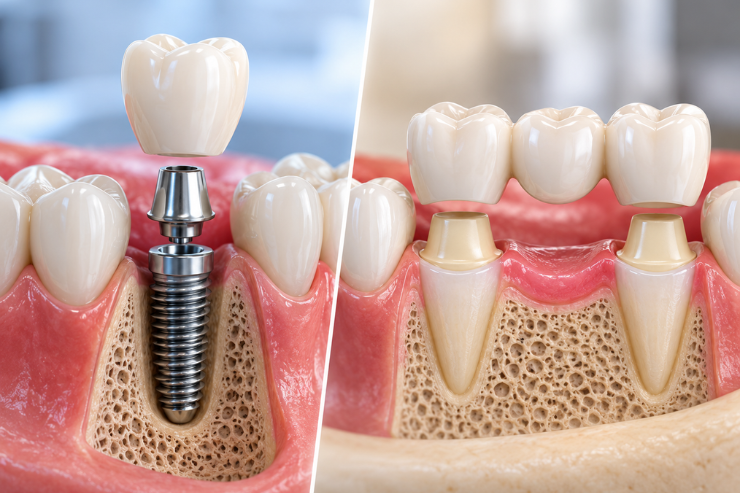
Dental implants typically last 15–25+ years, sometimes a lifetime, because they replace the tooth root and preserve jawbone. Bridges typically last 10–15 years, since they depend on the strength of the teeth beside the gap. Implants generally last longer, but the right choice depends on your bone health, budget, timeline, and the condition of your other teeth.
Both replace a missing tooth. Both look natural. But they work in very different ways, and that difference is exactly why one tends to outlast the other. Below, we break down how each works, what affects how long they last, and how to decide which one fits you.
Quick View: Dental Implant vs. Bridges
Dental Implant: Titanium post surgically placed in the jawbone, covered with a crown — replaces the tooth and root.
A dental implant replaces a tooth from the root up. It fuses with the bone over a few months in a process called osseointegration.
Because the implant post sits inside the bone, it also does something a bridge cannot: it keeps stimulating the jawbone every time you bite or chew, which helps prevent the bone loss that naturally follows tooth loss.
Dental Bridge: A fixed prosthetic anchored to the two adjacent (abutment) teeth, spanning the gap.
A dental bridge replaces a missing tooth by anchoring a prosthetic tooth to the two natural teeth on either side of the gap. Those neighbouring teeth are shaped and fitted with crowns, and the replacement tooth sits between them, literally “bridging” the space.
A bridge doesn’t involve surgery or a healing period the way an implant does. In many cases, it can be completed in two to three visits, which makes it a quicker route to a restored smile.
How the Treatment Process Compares
Implants:
- Consultation and imaging (X-ray or CT scan) to assess bone density
- Implant post placed into the jawbone
- Healing period of 3–6 months while the post fuses with bone
- Custom crown attached to complete the restoration
Bridges:
- Consultation and preparation of the adjacent teeth
- Impressions taken and a temporary bridge fitted
- Permanent bridge placed and adjusted, usually within a few weeks
Neither process is “better” on its own. Implants ask for more time upfront in exchange for a more self-contained, long-term solution. Bridges move faster but rely on your existing teeth to carry the load.
Dental Implant vs. Bridges: Which Lasts Longer?
This is the question most people are really asking, so here it is plainly:
| Dental Implants | Dental Bridges | |
| Average lifespan | 15–25+ years, often lifelong with care | 10–15 years |
| What it replaces | Tooth root + crown | Crown only, supported by neighbouring teeth |
| Effect on jawbone | Preserves bone through stimulation | Does not prevent bone loss |
| Impact on adjacent teeth | None | Adjacent teeth are reshaped and bear extra load |
| Treatment time | Longer (months, due to healing) | Shorter (weeks) |
Implants tend to last longer because they don’t depend on other teeth staying strong. A bridge is only as durable as the abutment teeth supporting it, and those teeth now carry extra pressure they weren’t originally designed for.
Over the years, that added strain can lead to decay or wear on the supporting teeth, which is often what limits a bridge’s lifespan rather than the bridge itself wearing out.
What Actually Affects Lifespan
If you’re planning to get a dental bridge or dental implant in Kolkata, here are a few factors that contribute to the longevity of the treatments:
- Oral hygiene — both implants and bridges need consistent brushing, flossing, and cleaning underneath or around them
- Bone density — implants need enough healthy jawbone to anchor into; this is assessed before treatment
- Condition of neighbouring teeth — for bridges, weak or decayed abutment teeth shorten the bridge’s life
- Bite force and grinding (bruxism) — unmanaged grinding puts extra stress on both options
- Regular dental check-ups — catching small issues early prevents bigger, costlier problems later
In short, your daily habits and routine care influence the outcome.
When a Dental Bridge Might Be the Right Choice
A bridge can be the more sensible option when:
- Your adjacent teeth already need crowns or restorative work
- You want a faster treatment timeline without a healing period
- You’re not a candidate for implant surgery due to bone loss or certain health conditions
- Budget is a more immediate concern than long-term cost
When a Dental Implant Might Be the Right Choice
An implant tends to make more sense when:
- Your neighbouring teeth are healthy and you’d rather not alter them
- You want to preserve your jawbone structure over the long term
- You’re looking for a standalone solution that doesn’t depend on other teeth
- You’re comfortable with a longer treatment timeline in exchange for durability
Cost vs Longevity: A Fair Look
Dental Implants usually cost more at the outset. In contrast, bridges cost less initially but may need to be replaced once or twice over your lifetime, and each replacement adds to the overall cost.
Implants, placed correctly and cared for well, are often the more economical choice over several decades simply because they’re replaced less often.
That said, cost isn’t the only factor, what treatment fits your dental condition is the determining factor.
How to Care for Dental Implants & Bridges?
Implants: Brush and floss as you would natural teeth, using implant-safe interdental brushes where needed, and keep up with regular cleanings.
Bridges: Clean under the pontic (the artificial tooth) using floss threaders or a water flosser, since food and plaque can collect in that space if left unaddressed.
Both options can comfortably reach or exceed their average lifespan when they’re cared for consistently.
So, Which One Should You Choose?
The purpose of implants is to preserve your jawbone health in a way bridges cannot. Bridges remain a strong, faster, and often more immediately affordable option, particularly when your adjacent teeth already need attention or when implant surgery isn’t suitable for you right now.
Every mouth is different, and the right choice between an implant and a bridge depends on factors like your bone density, gum health, and long-term goals. At Precision Dental & Implant Centre, a dental implant clinic in Kolkata, our team can assess your candidacy with a simple scan and walk you through which option fits your situation.
Book a consultation to find out the ideal dental care for you.
Author:
Dr. Sayak Gupta
BDS, MDS (Conservative Dentistry & Endodontics)
FICOI (USA), Assoc. Fellowship – Laser Dentistry (WCLI, USA)
Frequently Asked Questions
How long do dental implants and bridges really last?
Dental implants typically last 15–25 years or longer, and many patients keep them for life with proper care. Dental bridges typically last 10–15 years, depending on the health of the teeth supporting them.
Can a bridge be converted to an implant later?
Yes, in most cases. If a bridge fails or the abutment teeth are eventually lost, your dentist can often remove the bridge and place an implant instead, provided there’s enough healthy jawbone. A bone assessment will confirm whether this is possible for you.
Do implants hurt more than bridges?
Implant placement involves minor surgery, so some soreness is expected for a few days afterward, similar to a tooth extraction. Bridge preparation involves reshaping teeth, which can cause mild sensitivity. Both are manageable with local anaesthesia during the procedure and standard aftercare.
Is a bridge a permanent solution?
A bridge is a fixed solution, meaning it isn’t removable like a denture, but it isn’t permanent in the sense of lasting a lifetime. Most bridges need replacement after 10–15 years, depending on wear and the condition of the supporting teeth.
How much bone loss happens without an implant?
Without an implant or another root-replacing solution, the jawbone beneath a missing tooth begins to lose density fairly soon after extraction, since it no longer receives stimulation from chewing. This bone loss is gradual but continues over time, which is why implants are often recommended to help preserve jaw structure.
Which option is covered by insurance more often?
Coverage varies by provider and plan, so it’s worth checking directly with your insurer. Bridges have historically been more commonly covered, though many insurance plans now include partial coverage for implants as well. Your dental clinic can usually help you understand what your specific plan covers before you commit to a treatment.
Disclaimer: This content is for general educational purposes only and does not constitute medical advice. Individual results may vary. Please consult your treating doctor for a personalised assessment before starting any treatment.