

Did you notice yourself chewing only from one side? Soup becomes your safer option to order at restaurants. Nobody told you to do this, but your mouth just quietly adjusted around teeth gaps.
Missing several teeth in a row can make daily oral functions difficult long before it shows up as pain, gum cuts, or more serious dental complications. An implant-supported bridge is an advanced dental solution for multiple missing teeth. This blog explains when it’s a good option, how it works, and what patients often ask before deciding.
Why Implant-supported Bridges Suit Multiple Gaps
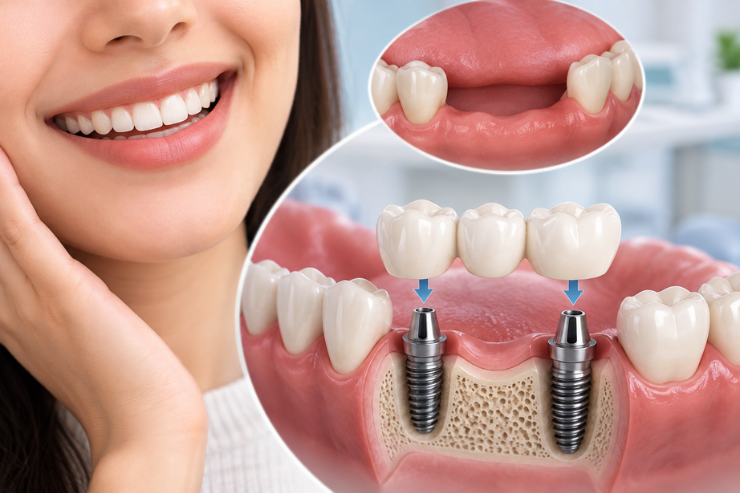
When two or three teeth are missing next to each other, replacing each one with a separate implant isn’t always necessary. An implant-supported bridge uses just a couple of implants to anchor the whole row, with connected crowns filling in the rest of the gap, which is often why dentists bring it up first as an option for multiple missing teeth in a row.
An implant-supported bridge tends to suit a case well when:
- Several missing teeth sit next to each other, rather than being scattered across the mouth
- The jawbone has enough quality and density to support the implants
- The surrounding gums are healthy
- There are no existing dental or medical conditions that would complicate healing
A dentist would examine all of these before discussing whether a bridge or single implants may be more appropriate. Individual results vary depending on a person’s oral health and bone quality.
How Implants Are Spaced to Support a Bridge
An implant-supported bridge usually uses two or three implants as anchor points, spaced out along the gap. A connected row of crowns then rests on top of these implants, replacing several teeth without needing one implant per tooth.
| Missing teeth | Implants often placed | Crowns typically supported |
| 3 teeth in a row | 2 implants | 3 connected crowns |
| 4 teeth in a row | 2 to 3 implants | 4 connected crowns |
| 5 or more teeth | 3 to 4 implants | 5 or more connected crowns |
These numbers are general guidelines used across dentistry, not a fixed rule. The exact plan is worked out after a clinical examination and imaging, and can differ from person to person.
How It Manages Bite Force on Nearby Teeth
Chewing puts steady pressure on the teeth every day. When a tooth goes missing, neighbouring teeth can end up carrying extra bite force, which over time may contribute to wear, shifting, or strain on those teeth.
An implant-supported bridge is designed to spread chewing pressure across the implants themselves, rather than letting that load fall on nearby natural teeth. This is one of the reasons dentists may consider an implant-supported bridge when several teeth are missing in a row. As with any dental treatment, comfort and outcomes can vary between individuals.
Implant-supported Bridge vs Dental Bridge
Patients exploring options for multiple missing teeth often come across two types of bridges. Here is a general, non-comparative look at both:
| Aspect | Implant-supported Bridge | Dental Bridge |
| Support structure | Anchored into the jawbone using implants | Anchored on natural teeth on either side of the gap |
| Neighbouring teeth | Left untouched | May need reshaping to hold the bridge |
| Jawbone | Implants can help maintain bone at the site | Bone under the gap may continue to change over time |
| Suitability | Depends on bone density and healing capacity | Depends on the strength of the adjacent teeth |
Removable dentures are another option that some patients in Kolkata consider for replacing multiple missing teeth. A dentist can explain how a denture compares with a fixed implant-supported bridge for a specific case. There is no single answer that fits everyone, the right choice depends on individual oral health, bone condition, and clinical assessment.
How to Care For Dental Bridges: Hygiene Tips
An implant-supported bridge needs a little extra attention during daily cleaning, since the area where the crowns join can be harder to reach with a regular toothbrush alone.
- Brush twice a day with a soft-bristled brush
- Use interdental brushes or a floss threader to clean under the bridge
- Keep up with regular dental check-ups for a professional review
- Avoid biting down on very hard foods, such as ice or hard candy
- Mention any looseness or discomfort to your dentist promptly
Good hygiene habits support the comfort and function of a bridge over time, though how well it holds up can still vary from person to person based on overall oral health and habits.
Treatment Planning and Cost Factors
No two mouths are exactly alike. The number of missing teeth, bone quality, gum health, and habits such as smoking can all influence what a dentist considers suitable. Before any treatment date is fixed, a dentist typically reviews X-rays or a CT scan, examines the gums and bone, and explains the reasoning behind the suggested plan.
For anyone researching dental implants cost in Kolkata, here are some of the factors that generally influence the estimate:
- Number of implants required
- Type of crown and bridge material selected
- Bone quality, and whether procedures like bone grafting are needed
- Number of visits and the follow-up care involved
- Diagnostic imaging and lab processes used
Since these factors differ from person to person, an accurate cost estimate is only possible after an in-person examination with a treating dentist.
Every Smile Deserves a Personalised Plan
A gap in your smile doesn’t stay quiet for long! It shows up in the side you chew on, the foods you quietly stop ordering, the laugh you catch yourself holding back. An implant-supported bridge is one of the treatments dentists may discuss for replacing several missing teeth in a row. Every case is different, and factors like bone health, the number of missing teeth, and personal preference all play a part in what’s suitable.
If you’re exploring options for missing teeth, a conversation with a qualified dentist is a good next step to understand what applies to your own oral health. Individual results and treatment plans vary from person to person.
Author:
Dr. Sayak Gupta
BDS, MDS (Conservative Dentistry & Endodontics)
FICOI (USA), Assoc. Fellowship – Laser Dentistry (WCLI, USA)
Frequently Asked Questions
1. How many implants are usually needed for a bridge replacing several teeth? This depends on how many teeth are missing and the bone available. Some plans support three to four crowns with two to three implants, but the exact number is confirmed only after a clinical exam.
2. Is getting an implant-supported bridge painful? Most patients report mild discomfort or swelling after the procedure, which is usually managed with prescribed medication. Pain levels vary between individuals, and a dentist will explain what to expect beforehand.
3. How long does treatment for an implant-supported bridge usually take? Treatment often happens in stages, including healing time after implant placement before the crowns are fitted. The full timeline depends on bone health and healing response, and can range from a few months onward.
4. Can implant-supported bridges be removed at home like dentures? No, an Implant-supported bridge is fixed in place and is not designed to be removed by the patient. This is different from removable dentures, which can be taken out for cleaning each day.
5. Who is generally considered suitable for an implant-supported bridge? Suitability depends on bone density, gum health, and overall health. A dentist evaluates these factors through an examination and imaging before recommending any specific treatment plan.
Disclaimer: This content is for general educational purposes only and does not constitute medical advice. Individual results may vary. Please consult your treating doctor for a personalised assessment before starting any treatment.