

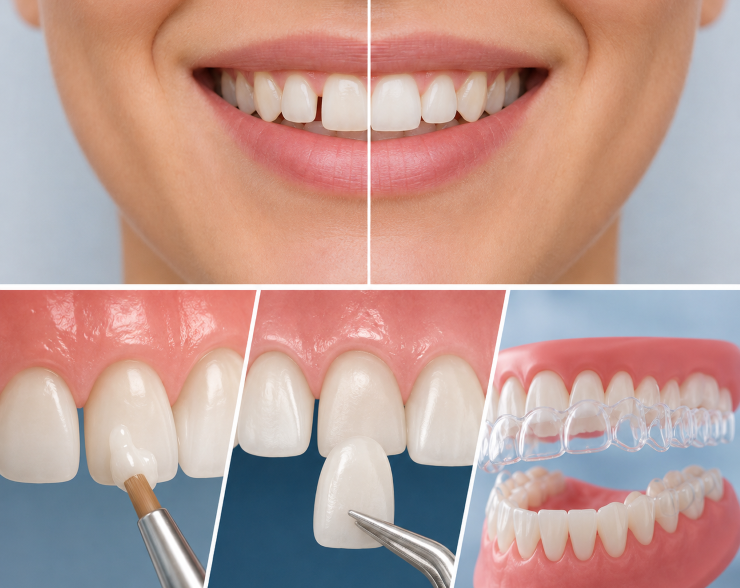
In clinical practice, a gap between the front teeth what dentists call a diastema is one of the most common cosmetic concerns patients raise. The question I hear most often is direct: which treatment actually closes a gap for good?
There is no single answer that applies to every case. The size of the gap, what caused it, and the patient’s bite all determine whether bonding, veneers, or aligners is the more suitable option.
What Is a Front-Teeth Gap?
A diastema is simply a visible space between two teeth, most commonly seen between the upper front teeth.
Not every gap needs treatment.
- A cosmetic gap doesn’t affect function — it’s purely an appearance concern
- A functional gap can affect food trapping, speech clarity, chewing efficiency, or overall bite alignment
Whether a gap is treated for looks or for function changes how it’s approached clinically.
What Causes Gaps Between Front Teeth?
A gap rarely appears without a reason. Common causes include:
- Tooth-to-jaw size mismatch — teeth smaller than the jaw can accommodate
- Naturally small or missing teeth — often the lateral incisors
- Childhood habits — tongue-thrusting or prolonged thumb sucking
- Post-orthodontic shifting — teeth moving after braces or aligners without a retainer
- Gum disease or bone loss — teeth drifting apart as support weakens
- Bite and alignment problems — uneven forces pushing teeth apart
A gap that’s new or widening in an adult should be evaluated before any cosmetic treatment, since it can signal an underlying gum or alignment issue rather than a purely cosmetic one.
Can Front-Teeth Gaps Be Closed Without Braces?
Yes, in certain cases.
Small, cosmetic gaps can sometimes be masked using bonding or veneers, without moving the teeth at all. Aligners or braces, on the other hand, physically move the teeth to close the actual space.
The correct choice depends on the cause of the gap, its size, tooth proportions, the bite, and overall oral health — not on preference alone.
Dental Bonding for Front-Teeth Gaps
Bonding uses tooth-coloured composite resin, added directly onto the tooth and shaped to close the gap.
How It Works
- Composite is applied in layers and sculpted to match the natural tooth shape
- Minimal to no tooth preparation is usually required
- Typically completed in a single appointment
- Shade is matched to surrounding teeth for a natural appearance
What to Expect
- Staining, chipping, or the need for polishing over time
- Repairs or touch-ups are usually straightforward
- Less durable than veneers, but a reversible, lower-intervention option
Who May Not Be an Ideal Candidate
- Patients with heavily stained or structurally weak teeth
- Wider gaps where added resin cannot achieve a natural proportion
- Cases where the gap is linked to an active bite or gum issue
Veneers for Front-Teeth Gaps
Veneers mask a gap by changing the visible width and shape of the teeth, rather than adding a small patch of material.
Composite vs Porcelain Veneers
- Composite veneers — built up directly on the tooth, similar to bonding but covering a larger surface; more affordable, less stain-resistant
- Porcelain veneers — custom-fabricated shells bonded onto the tooth; longer-lasting, more stain-resistant, higher cost
How It Works
- A thin layer of enamel is typically prepared before placement
- Ideal when colour, shape, chips, or unevenness need correcting alongside the gap
- Usually completed over one to two visits
What to Expect
- Higher durability and stain resistance than bonding
- Some veneer types involve irreversible enamel removal — this should be discussed clearly before proceeding
- Repair or replacement is possible later if damaged
Per general dental guidance, veneers can effectively mask gaps, but any existing decay or gum disease should be treated first, since veneers are a cosmetic solution, not a substitute for underlying dental health.
A structured smile design treatment approach maps the ideal shape and proportion of each veneer in advance, so the final result is planned rather than adjusted after the fact.
Clear Aligners for Front-Teeth Gaps
Aligners don’t cover or widen the appearance of a tooth — they physically move it, closing the gap through gradual, controlled pressure.
How It Works
- Digital scans are used to plan the full movement sequence in advance
- A series of custom, removable trays are worn and changed progressively
- Regular monitoring tracks progress against the treatment plan
What to Expect
- Daily wear of roughly 20–22 hours is required to stay on track
- Treatment duration varies with case complexity, typically several months
- A retainer is essential after treatment to prevent the gap from reopening
Aligners are commonly used for gapped teeth, especially when spacing is combined with mild crowding, rotation, or bite issues. Larger gaps or more complex bite problems are sometimes managed more predictably with traditional braces instead.
Bonding vs Veneers vs Aligners: Comparison
| Factor | Bonding | Veneers | Aligners |
| What it does | Adds material to the tooth | Covers the front surface | Moves the tooth |
| Best for | Small cosmetic gaps | Gaps with colour or shape concerns | Spacing with alignment issues |
| Tooth alteration | Usually minimal | May require enamel removal | No cosmetic covering involved |
| Treatment time | Usually shortest | Short to moderate | Usually longer |
| Stain resistance | Lower | Higher with porcelain | Not applicable |
| Maintenance | Polishing or repairs | Possible repair or replacement | Retainer required |
| Main limitation | Can stain or chip | Often irreversible | Requires consistent wear |
No single treatment is universally the “best” choice — the right decision depends on an accurate diagnosis and the patient’s individual priorities.
Which Treatment Suits Which Situation?
The right treatment often becomes clearer once the specific situation is matched against it:
- A very small gap with otherwise well-aligned teeth — bonding may be considered
- A gap alongside staining, chipping, or uneven tooth shape — veneers may be considered
- A gap caused by tooth position or accompanied by bite problems — aligners or braces may be more suitable
- A gap caused by a missing tooth — orthodontic movement and tooth replacement may both be needed
- A newly developing gap — gum and bone health should be assessed before anything cosmetic is planned
Can These Treatments Be Combined?
A smile design treatment plan often involves more than one approach working together, such as:
- Aligners followed by bonding for final shape refinement
- Aligners followed by veneers for a complete cosmetic result
- Gum contouring paired with bonding or veneers
- Teeth whitening completed before selecting a bonding or veneer shade
- Orthodontic movement followed by replacement of a missing tooth
Sequencing matters. Later procedures need to match the final tooth position and shade, so planning the full sequence in advance avoids mismatched results.
Treatment Time, Cost, and Longevity
Several factors influence how long treatment takes and what it costs overall:
- Number of visits required
- Total treatment duration
- Whether the case involves one tooth or a full smile plan
- Likelihood of future repair or replacement
- Retainer requirements after aligner treatment
- Follow-up appointments needed for maintenance
Costs vary meaningfully case to case, so a clinical evaluation is the only reliable way to get an accurate estimate for a specific situation.
Before-and-After Expectations
Setting the right expectations upfront avoids disappointment later.
What to Expect
- A visible reduction or closure of the gap, appropriate to the treatment chosen
- A result that matches natural tooth shade and proportion, when planned properly
- Gradual, staged change with aligners — not an instant transformation
- Immediate change with bonding or veneers, visible right after the appointment
- Some degree of long-term maintenance, whether that’s polishing, retainer wear, or periodic review
What Not to Expect
- An identical result to another patient’s case, even with the same treatment
- A permanent, zero-maintenance fix — every option needs some form of upkeep over time
- A guaranteed outcome, since individual healing, tooth structure, and habits all influence the result
- A treatment that corrects an underlying bite or gum issue if that issue hasn’t been addressed first
Individual results vary based on gap size, oral health, and how closely aftercare instructions are followed. A proper clinical examination remains the only reliable way to know what a specific case can realistically achieve.
Risks and Limitations
Every option carries trade-offs worth knowing before deciding:
- Bonding can stain, chip, or need reshaping over time
- Veneers may involve enamel removal and can eventually need repair or replacement
- Aligners require consistent daily wear and long-term retention to hold results
- Closing a gap without identifying its underlying cause can produce unstable results that relapse
- Gum disease, decay, or other active oral-health issues should always be treated before any cosmetic work begins
A Word on Expectations
Individual results vary based on gap size, oral health, and how closely aftercare instructions are followed. No treatment guarantees an identical outcome for every patient, and a proper clinical examination remains the only reliable way to determine which option applies to a specific case.
Final Thoughts
Bonding, veneers, and aligners each solve the “gap problem” differently one adds material, one covers the tooth, and one moves the tooth. None is universally better; the right choice depends entirely on the gap, the bite, and the long-term goal in mind.
A detailed consultation with a qualified dentist remains the most reliable way to map out the right path forward whether that turns out to be a single-sitting fix, a smile design treatment, or a combination of approaches. Anyone comparing options at a dental clinic in Kolkata is better placed to decide once the gap has been properly assessed in person, rather than choosing a treatment based on appearance alone.
Author:
Dr. Sayak Gupta
BDS, MDS (Conservative Dentistry & Endodontics)
FICOI (USA), Assoc. Fellowship – Laser Dentistry (WCLI, USA)
Frequently Asked Questions
1. Can a gap between front teeth close on its own without treatment?
No, a gap won’t close by itself in adults. Once the jaw has finished growing, the space stays the same or can even get slightly bigger over time, especially if it’s linked to gum health. Some form of treatment is needed to close it.
2. Which is cheaper — bonding or veneers?
Bonding usually costs less than veneers because it uses a simpler material and takes less chair time. Veneers cost more upfront but tend to last longer and resist staining better, so many people see it as a longer-term investment rather than a quick fix.
3. Do aligners hurt when closing a gap?
Mild pressure or tightness is common for the first day or two after switching to a new tray — this is a sign the teeth are moving. It’s not the sharp pain people often imagine, and it usually settles down quickly.
4. Will bonding or veneers stain like natural teeth?
Veneers resist staining quite well because of the material used. Bonding, on the other hand, can pick up stains over time from coffee, tea, or smoking, similar to natural enamel, so it may need occasional polishing or replacement.
5. Can veneers work for someone with a slight gap and crooked teeth?
It depends on how crooked the teeth are. A slight gap combined with minor misalignment can sometimes be managed with veneers alone. But if the misalignment is more noticeable, aligners are usually recommended first to straighten things out, followed by veneers if needed for final polish.
This content is for general educational purposes and does not constitute medical advice. Individual results vary. Please consult a qualified dental practitioner for a personalised assessment.