
Your dentist recommends a dental implant. You nod. But somewhere in the back of your mind, one question lingers — how does a metal screw placed in your jaw actually become a tooth? The science behind it is more fascinating than most people expect — and understanding it is the difference between choosing your treatment blindly and choosing it with complete confidence.
Why Does Losing a Tooth Cause More Problems Than You Think?
A missing tooth is not just a gap in your smile. It triggers a chain reaction inside your jaw that most people are completely unaware of.
Your tooth root transmits bite pressure into the jawbone every time you chew. That pressure is what signals the bone to stay dense and active.
When the tooth is gone, that signal disappears.
What Happens Next
- Without stimulation, the jawbone begins to shrink — a process called bone resorption
- In the first year after tooth loss, you can lose up to 25% of bone volume at that site
- Over years, this changes the shape of your face, weakens neighbouring teeth, and makes future tooth replacement significantly harder
This is what a dental implant is designed to stop.
What Is a Dental Implant?
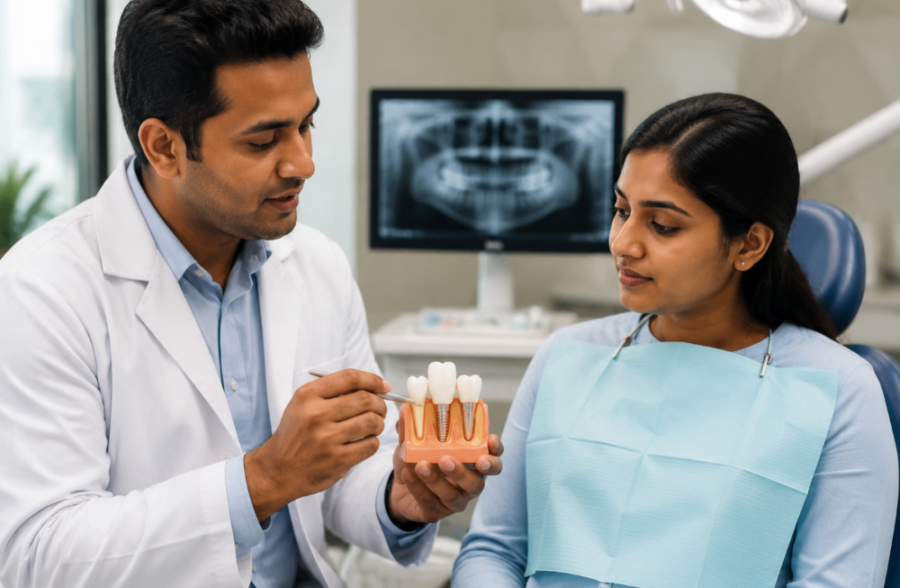
A dental implant is an artificial tooth root — a small screw, typically 3 to 5 mm in diameter and 8 to 16 mm long — made from medical-grade titanium.
It is placed directly into the jawbone, occupying exactly the space the natural root once held.
The Three Components
- The implant post — the titanium screw placed inside the jawbone
- The abutment — a connector piece that sits on top of the post
- The crown — the custom-made visible tooth fixed on the abutment
Together, these three components replicate a natural tooth from root to tip. But the implant’s real function is not cosmetic. It is mechanical and biological.
Why Does the Body Accept Titanium?
Titanium has a unique property: it is osseointegrative. This means living bone cells actively grow onto and into the titanium surface, forming a direct structural bond. There is no cement, no adhesive, no intermediary layer. The bone and the implant become one continuous structure.
The Science Behind It
- Titanium naturally forms a thin oxide layer on its surface the moment it contacts air
- Bone cells called osteoblasts recognise this surface chemistry and attach to it as though it were natural tissue
- The body does not try to wall it off or reject it — it incorporates it
This process is called osseointegration, and it is the biological foundation that makes dental implants work.
What Happens During Osseointegration?
After the implant is placed into the jawbone, the healing phase begins. Here is what is happening inside the bone during those weeks:
The Healing Timeline
- Days 1–7: A blood clot forms around the implant. Early healing tissue begins to develop.
- Weeks 2–4: Soft, immature bone tissue called woven bone starts forming around the implant surface.
- Weeks 4–12: The woven bone gradually matures and mineralises into dense, load-bearing bone.
- Months 3–6: The implant is now fully integrated — the bone has locked around every surface contour of the titanium screw.
At this point, the implant can bear the full force of chewing — which in adults ranges from 70 to 150 pounds of pressure per square inch on the back teeth.
How Does an Implant Feel Like a Real Tooth?
Natural teeth are not rigidly fused to bone. They sit in a cushioning structure called the periodontal ligament — a network of fibres that absorbs shock. It gives teeth a barely noticeable movement when you bite down and continuously feeds sensory signals back to your brain. .
Implants do not have a periodontal ligament. They are fused directly to bone, which means there is fractionally less sensory feedback when you bite.
Why You Won’t Notice the Difference
- The crown is shaped, sized, and positioned to distribute bite force naturally
- Within weeks of getting the final crown, the brain recalibrates
- The implant simply feels like a tooth
How Does an Implant Preserve the Jawbone?
This is where the implant does something no other tooth replacement can.
Every time you chew on an implant, bite pressure travels down through the crown, through the abutment, through the titanium post, and into the bone — exactly as it would with a natural tooth root.
Why Other Options Cannot Do This
- That mechanical stimulation tells bone cells to keep regenerating
- The bone stays dense, the jaw maintains its shape, the face retains its structure
- Dentures and bridges sit above the gum line — they transmit no force into the bone
- Bone resorption continues under them regardless
This is why implants are not just a cosmetic solution. They are a structural one.
What Determines Whether an Implant Will Succeed?
For anyone considering dental implants in Kolkata, understanding what makes an implant succeed is just as important as understanding how it works.
Three things matter most:
Bone Density and Volume
There needs to be enough bone at the implant site to hold and integrate the post. If bone has already been lost, a bone graft procedure can rebuild it before implant placement.
Precision of Placement
Modern implant surgery uses 3D CBCT imaging to map the exact position of nerves, sinuses, and bone walls before a single incision is made. Guided surgical templates translate that digital plan directly into the mouth with millimetre accuracy.
Patient Health
Conditions like uncontrolled diabetes or heavy smoking impair blood flow and slow the bone-healing process. These do not automatically disqualify someone but must be managed carefully.
With the right assessment and technique, implant success rates consistently exceed 95% over ten years.
How Long Do Dental Implants Last?
The Implant Root
The titanium root, once integrated, can last a lifetime. It does not decay. It does not weaken under normal chewing forces. It does not require replacement the way a natural root might deteriorate.
The Crown
The crown on top — subject to daily wear, grinding, and biting forces — may need replacement after 15 to 20 years. This is a straightforward procedure that does not disturb the implant beneath.
No other tooth replacement option comes close to this lifespan. A good dental clinic in Kolkata will walk you through exactly what to expect at every stage — including long-term maintenance — before you commit to treatment.
Take the Next Step
A missing tooth does more damage than most people realise — and the longer you wait, the more bone you lose.
At Precision Dental & Implant Centre, Dr. Sayak Gupta has placed hundreds of implants using 3D-guided planning and internationally certified implant systems. As one of the most trusted dental clinics in Kolkata for implant dentistry, the focus here is simple — the right treatment, done right, the first time.
Book your consultation today.
FAQs
Why do implants feel so much more natural than dentures?
Dentures rest on top of the gums and move slightly when you speak or chew — which is why many people feel self-conscious wearing them. An implant is anchored inside the bone. It does not move at all. The crown is fixed, stable, and shaped exactly like your natural tooth. Over a few weeks, your brain stops registering it as foreign and treats it as part of your mouth.
Can an implant fail after it has already integrated?
Yes, though it is uncommon. Late implant failure — after successful osseointegration — is usually linked to advanced gum disease around the implant (called peri-implantitis), trauma, or uncontrolled systemic conditions. Good oral hygiene and regular dental check-ups significantly reduce this risk.
Does the implant procedure hurt?
The placement is done under local anaesthesia. You will feel pressure and movement but not pain during the procedure. Post-operative soreness is typically mild — most patients manage it with standard over-the-counter pain relief and find it resolves within 3 to 5 days. Many say it was noticeably easier than they expected.
If I’ve had a missing tooth for years, can I still get an implant?
Possibly, but bone loss needs to be assessed first. The longer a tooth has been missing, the more bone resorption will have occurred at that site. A 3D scan will show how much bone remains. If volume is insufficient, a bone graft can rebuild it — though this adds time to the overall treatment.
Are the implant brands used in India the same as abroad?
At quality clinics, yes. Internationally certified implant systems — the same brands used in the UK, Canada, and the US — are available in India. What matters is verifying that your clinic discloses the implant brand and system being used, and that your surgeon holds a recognised implantology qualification.